
Advanced Digital Transformation of SMEs
- Status
- Closed
- Opening
- 23-02-2023
- Deadline
- 23-02-2024
- Subsidy
- 25%–75%
- Investment
- +150.000.000,00€
The programme
Action 2 – Advanced Digital Transformation of SMEs concerns enterprises that aim to broaden their digital and technological maturity with integrated investments in new ICT that will upgrade their competitiveness.
The main aim of Action 2 – Advanced Digital Transformation of SMEs is the upgrading of SMEs of Medium Digital maturity through the use of advanced systems and technologies with which they can improve their position in international markets, strengthen their operational flexibility, improve the production process and upgrade their competitiveness.
The Action encourages, as a priority, the implementation of targeted digital transformation investment plans that contribute significantly to an extroverted, innovative, competitive and sustainable operation of enterprises that produce products and provide services of higher added value.
Who it concerns
Existing medium-sized, small and micro enterprises, as defined in Commission Recommendation 2003/361/EC.
The basic conditions for participation of the enterprises that submit a funding application are the following, on the date of electronic submission of the funding application:
1. They submit one single funding application per tax identification number (AFM)
2. They operate in Greek territory and make an investment exclusively in one single Category of Region (with the same aid intensity).
3. They keep single-entry or double-entry books and have at least one (1) full closed financial year
4. They have been active in the eligible KAD code of the investment plan for at least one (1) year
5. They hold at least one eligible activity KAD code when the funding application for the investment plan is submitted
6. The investment concerns an eligible KAD code
7. They have at least five (5) AWU of salaried employment in the calendar year before the funding application is submitted
8. When submitting the funding application they provide a solemn declaration that the private contribution is secured at a rate of at least 25%. The private contribution must not contain any element of state support.
9. The investment plans must have the character of an initial investment, as defined in Article 13 "Scope of regional aid" and Article 14 "Regional investment aid" of Regulation (EU) 651/2014
10. Work on the investment plan must not have started before the aid application is submitted. Otherwise the whole investment plan becomes non-eligible for funding
11. They score at least 80 in the digital maturity questionnaire of this call
In addition, all of the following conditions must be met on the date of electronic submission of the funding application:
12. They have the status of an SME under the SME Definition of EU Recommendation 2003/361/EC, taking into account the terms for keeping that status
13. They operate lawfully and hold the appropriate operating licence under the legislation in force
14. They are not undertakings in difficulty
15. They are not in bankruptcy, liquidation or compulsory administration
16. They meet the conditions for applying Regulation (EU) 651/2014 (GBER)
17. They confirm that, in the two years before the application for aid, they have not relocated to the establishment in which the initial investment for which aid is requested will take place, and they commit not to do so for a maximum period of two years after the completion of the initial investment for which aid is requested (only for enterprises that will apply under Article 14 of Regulation (EU) 651/2014).
18. For investment plans submitted under the funding regime of Regulation (EU) 651/2014, and specifically Article 14, the investment must be maintained in the area where the aid is granted for at least three years after its completion. This does not prevent the replacement of equipment that has become outdated or has broken down within that period, provided the economic activity is maintained in the area concerned for the relevant minimum period required
19. They score at least 50 in total on the scored criteria, which concern the description of the submitted investment plan, the number of employees (AWU) and the digital maturity of the enterprise (Section B Scored Evaluation Criteria)
The following are not entitled to submit a funding application:
- Financial and insurance institutions, public bodies or public organisations and/or their subsidiaries, public enterprises, Legal Entities under Public Law (NPDD), as well as companies in whose capital or voting rights the local authorities (OTA) and all the above public bodies, individually or jointly, participate directly or indirectly with more than twenty-five per cent (25%) (and enterprises treated as such, as main partners). In addition, sports clubs and associations of every kind, sports sociétés anonymes, and enterprises related to the above categories in any way (for example: parent, subsidiary, affiliated or partner company, common ownership/management through natural persons etc.) are not entitled to submit a funding application.
- Enterprises that belong to an already organised uniform network for distributing products or providing services and which, under relevant contracts, use licences to exploit intellectual property rights, usually concerning trade marks or trade names and know-how for the use and distribution of goods or services (e.g. franchising, shop in shop, agency network etc.).
- Offshore enterprises
- Enterprises whose main activities fall under Section K "Financial and insurance activities" of NACE Rev. 2, or enterprises that carry out intra-group activities and whose main activities fall under classes 70.10 "Activities of head offices" or 70.22 "Business and other management consultancy activities" of NACE Rev. 2.
- Enterprises that belong to the sectors excluded from Regulation (EU) 651/2014, as described in Annex IX "GBER conditions" of this call. Where enterprises are active in the sectors mentioned above and also in one or more of the eligible activity codes, Regulation 651/2014 applies to the aid granted for the eligible activities, provided the activities are separated or the costs are distinguished, so that the activities in the sectors excluded from the scope of these regulations do not receive aid.
Please note that:
- Co-location of enterprises is not allowed. Co-location means that the enterprise is installed in the same, non-distinct space as another enterprise. If co-location of enterprises is found, the inclusion decision will be revoked.
- Not accepted are enterprises whose place of implementation is the beneficiary's home (main or secondary).
Special matters of Regulation (EU) 651/2014 (GBER)
Please note that the investment plans submitted under this action, in accordance with Regulation (EU) 651/2014 (GBER), must have the character of an initial investment and specifically meet one of the following:
- Setting up a new establishment.
- Extension of the capacity of an existing establishment. The additional capacity of the establishment due to the investment plan can be accepted only if the existing capacity of the establishment can be certified by official supporting evidence.
- Diversification of the output of an establishment into products or services not previously produced in it
- A fundamental change in the overall production process of an existing establishment.
Digital maturity ranking of the enterprise
Every applicant enterprise must meet a minimum digital maturity, judged by the level of existing technologies, applications and equipment it has in operation. The ranking is based on the criteria of the following digital maturity questionnaire, which aims to connect enterprises with suitable services, equipment and systems that upgrade their digital operation.
|
DIGITAL MATURITY QUESTIONNAIRE MEDIUM TIER |
|||
|
No. |
Medium-Tier Maturity Evaluation Criteria |
Criterion Fully Met |
Weight |
|
1 |
Digital security applications, such as protection of users and devices against viruses, or firewall management, or a proxy server (VPN) |
Yes/No |
20% |
|
2 |
Word processing and presentation applications, and email and calendar |
Yes/No |
20% |
|
3 |
Applications for digital invoicing of transactions for customers or suppliers |
Yes/No |
20% |
|
4 |
Connection to UFBB/SFBB networks and wired network equipment or wireless network equipment |
Yes/No |
20% |
|
5 |
Online shop (e-shop) with functions for taking orders, checking availability in real time and online payment. |
Yes/No |
20% |
|
TOTAL: |
100% |
||
Based on the above criteria, enterprises receive a score of 100 if they fully meet each criterion, or a score of 0 if they do not fully meet it.
The final ranking score (K) of the beneficiaries ranges from 0 to 100 points
K = score of Criterion 1 * 0.2 + score of Criterion 2 * 0.2 + score of Criterion 3 * 0.2 + score of Criterion 4 * 0.2 + score of Criterion 5 * 0.2
Applications from enterprises with a score K below 80 cannot be submitted.
The correct completion of the questionnaire is documented by the beneficiary providing the corresponding supporting documents digitally when the funding application is submitted. The correctness of the completed questionnaire is confirmed by the Intermediate Body during the evaluation.
If the check of the supporting documents shows that the enterprise ranks at a digital maturity level K below 80, the investment plan is rejected.
The enterprise must keep, as a minimum, the digital maturity it has when the funding application is submitted, up to and including the date the physical and financial scope of the investment plan is completed.
Program budget
The budget of this Action amounts to a total of €150,000,000 (Public Expenditure) and is distributed among the regions of the country
The minimum and maximum total aided budget of the funding application is set from €50,000 up to €650,000.
The subsidised budget of the investment plan may not exceed three times the highest turnover achieved in one of the three (or fewer, if the enterprise does not have three) financial periods before the year the funding application is submitted, with a ceiling of €650,000.
The Public Expenditure is co-financed by the European Regional Development Fund (ERDF) of the European Union and by National Participation.
Amount of subsidy
The investment plans submitted must comply with the conditions of the funding regime of Regulation (EU) 651/2014 (GBER) set out in Articles 13 "Scope of regional aid", 14 "Regional investment aid", 17 "Investment aid to SMEs" and 18 "Aid for consultancy in favour of SMEs".
Please note that investment plans under Article 14 must have the character of an initial investment and specifically one of the following must be met:
1) Setting up a new establishment.
2) Extension of the capacity of an existing establishment. The additional capacity of the establishment due to the investment plan can be accepted only if the existing capacity of the establishment can be certified by official supporting evidence.
3) Diversification of the output of an establishment into products or services not previously produced in it, on condition that the eligible expenses exceed by at least 200 % the book value of the assets that are reused, as registered in the financial year before the start of works.
4) A fundamental change in the overall production process of an existing establishment.
For the expenses aided under Article 14 "Regional investment aid" of the GBER, the aid intensities are as follows (Regional Aid Map 2022-2027):
|
Aid intensity (%) under Article 14 GBER |
|||||
|
Eligible Expenses (Under Article 14) |
Regions / Regional Units for which the aid is granted under Art. 14 of Regulation (EU) 651/2014 |
Public Grant (%) Up to |
Private Contribution (%) Up to |
||
|
Medium-Sized Enterprises |
Small & Micro Enterprises |
Medium-Sized Enterprises |
Small & Micro Enterprises |
||
|
North Aegean, |
|||||
|
Crete, Eastern |
|||||
|
Macedonia – |
|||||
|
Thrace, Central |
|||||
|
Macedonia, |
|||||
|
Western |
|||||
|
1. Equipment |
Macedonia, |
50% |
50% |
50% |
50% |
|
Expenses |
Epirus, |
||||
|
2. Software |
Thessaly, Ionian |
||||
|
Expenses |
Islands, Western Greece, Central |
||||
|
Greece, |
|||||
|
Peloponnese |
|||||
|
South Aegean |
40% |
50% |
60% |
50% |
|
|
Western Sector |
25% |
35% |
75% |
65% |
|
|
of Athens |
|||||
|
East Attica |
35% |
45% |
65% |
55% |
|
|
West Attica |
35% |
45% |
65% |
55% |
|
|
Piraeus, Islands |
35% |
45% |
65% |
55% |
Please note that the aid intensity, expressed in gross grant equivalent, does not exceed the maximum aid intensity set in the regional aid map 2022-2027.
For the expenses aided under Article 17 "Investment aid to SMEs" of the GBER (only for enterprises of the Central, Northern and Southern Sectors of Athens), the aid intensities are as follows:
|
Aid Intensity (Article 17 GBER) |
||||
|
Eligible Expenses (Under Article 17) |
Public Grant (%) up to |
Private Contribution (%) |
||
|
Medium-Sized Enterprises |
Small & Micro Enterprises |
Medium-Sized Enterprises |
Small & Micro Enterprises |
|
|
Up to 10 % |
Up to 20 % |
Up to 90 % |
Up to 80 % |
Please note that Article 17 covers the eligible expenses of enterprises of the Central, Northern and Southern Sectors of Athens only.
For the expenses aided under Article 18 "Aid for consultancy in favour of SMEs" of the GBER, the aid intensities are as follows:
|
Aid Intensity (Article 18 GBER) |
||||
|
Eligible Expenses (Under Article 18) |
Public Grant (%) up to |
Private Contribution (%) up to |
||
|
Medium-Sized Enterprises |
Small & Micro Enterprises |
Medium-Sized Enterprises |
Small & Micro Enterprises |
|
|
1. Expenses for the Provision of Services |
Up to 50 % |
Up to 50 % |
Up to 50 % |
Up to 50 % |
Please note that the aid intensity does not exceed 50 % of the eligible expenses.
Eligible expenses
The main categories of expenses covered by Action 2 – Advanced Digital Transformation of SMEs are the following:
1) Equipment Expenses, with indicative expenses: Supply of advanced systems for operating facilities or staff, for automating production with robotic systems, CNC machines, 3D printers, 3D scanners, upgrading of internal data networks etc.
2) Equipment Expenses for the Production of modern technological equipment and advanced digital systems, with indicative but focused expenses: Supply of advanced technological systems and mechanical equipment for producing Industry 4.0 systems and equipment, security systems and equipment (e.g. site surveillance, cyber-protection etc.), automation systems, robotic systems
3) Software Expenses, with indicative expenses: Supply of modern applications for administrative and financial planning, digital security, customer and supply chain management, data analysis with artificial intelligence tools, production optimisation, upgrading of the services provided etc.
4) Expenses for the Provision of Services linked to the digital upgrade, with indicative expenses: Technical support for configuring and integrating the new systems into the operation of the SMEs, certification of systems etc.
The eligible expenses receive aid in the form of a grant and concern:
a) Investment expenses in intangible and tangible assets (Article 14 of Regulation (EU) 651/2014) in the following categories of Expenses:
- Equipment Expenses
- Software Expenses
b) Investment expenses in intangible and tangible assets (Article 17 of Regulation (EU) 651/2014, for enterprises of the Central, Northern and Southern Sectors of Athens) in the following categories of Expenses:
- Equipment Expenses
- Software Expenses
c) Expenses for consultancy and support services (Article 18 of Regulation (EU) 651/2014) in the following categories of Expenses:
- Expenses for the Provision of Services
A breakdown of the eligible expenses of the Action follows:
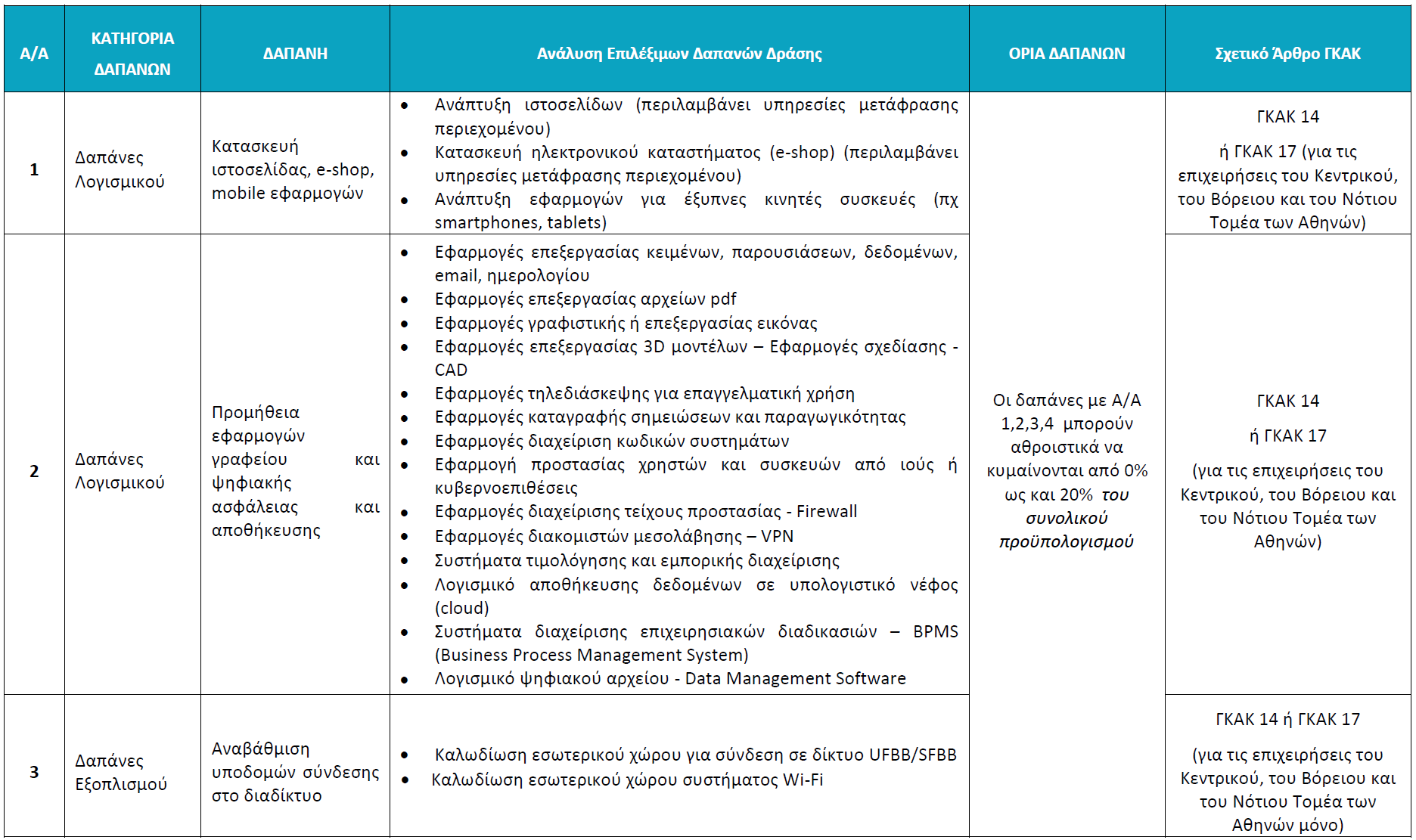
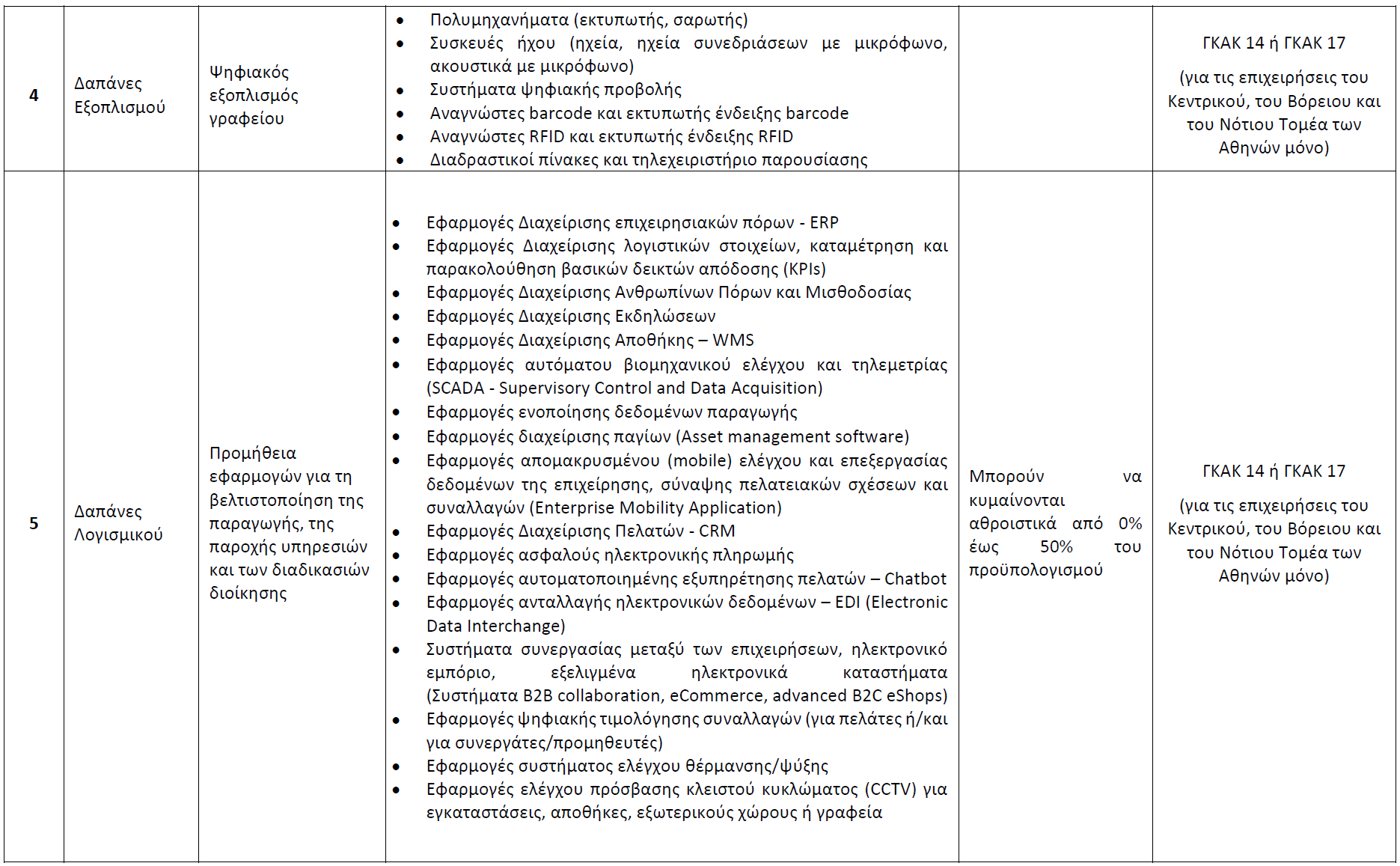
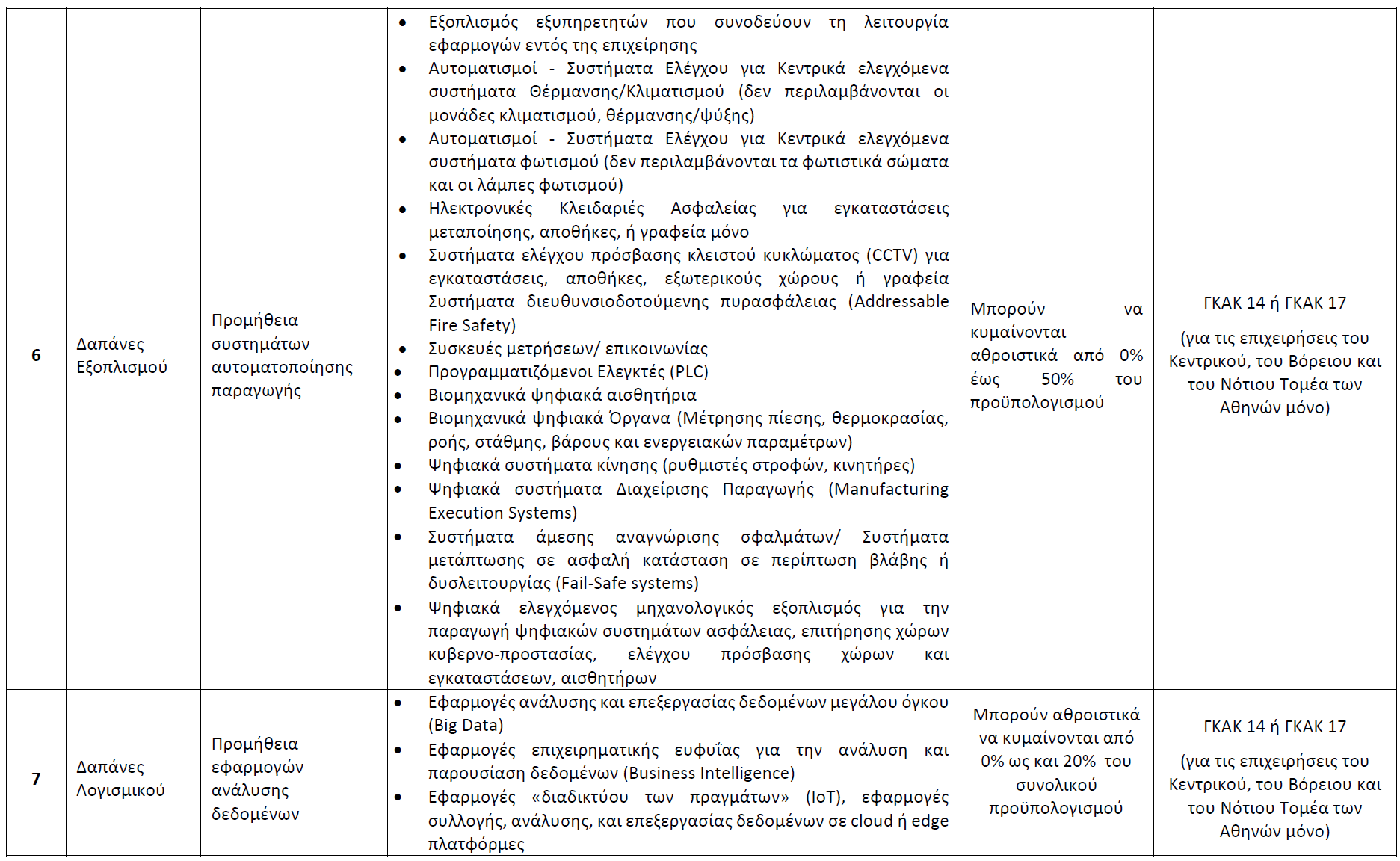
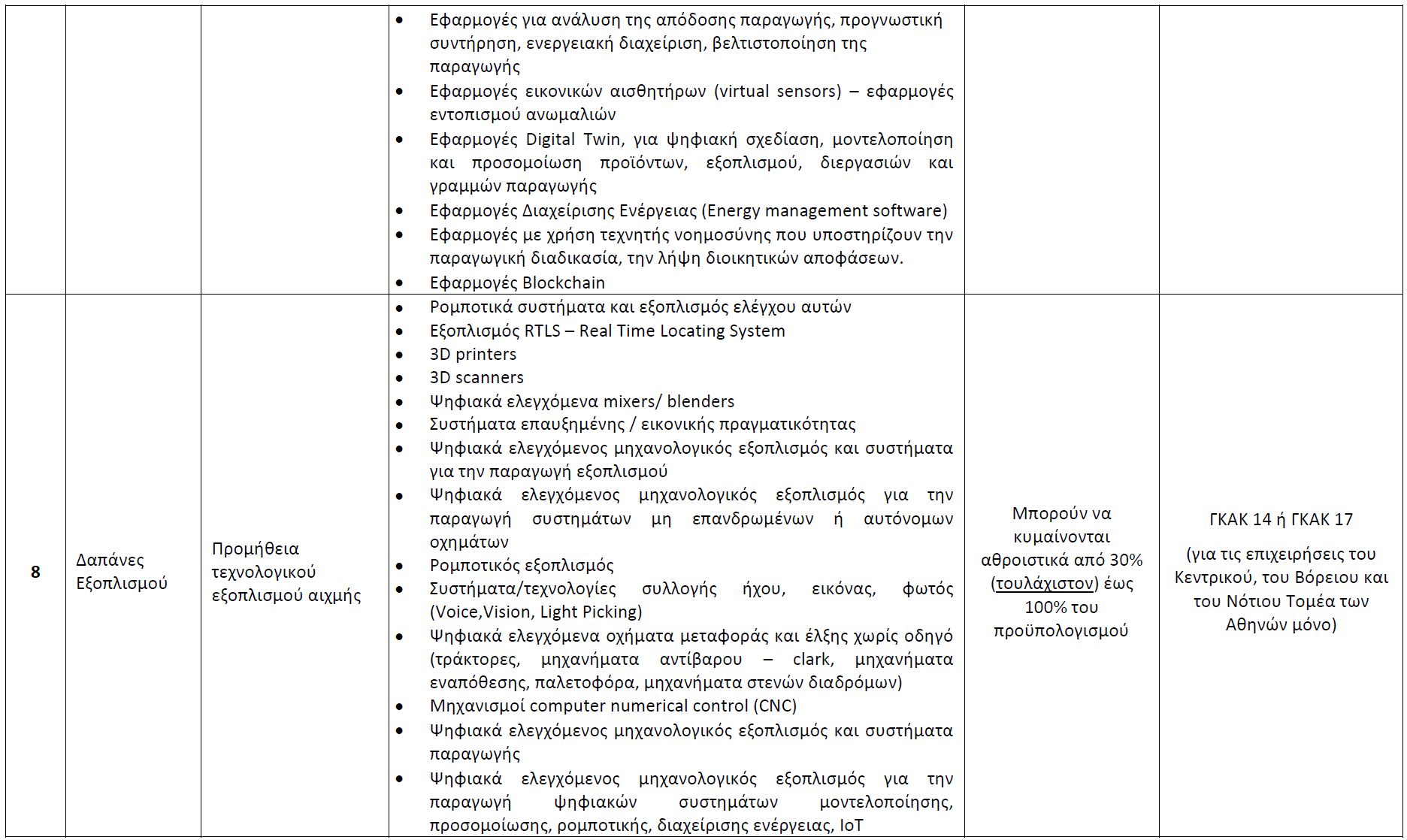
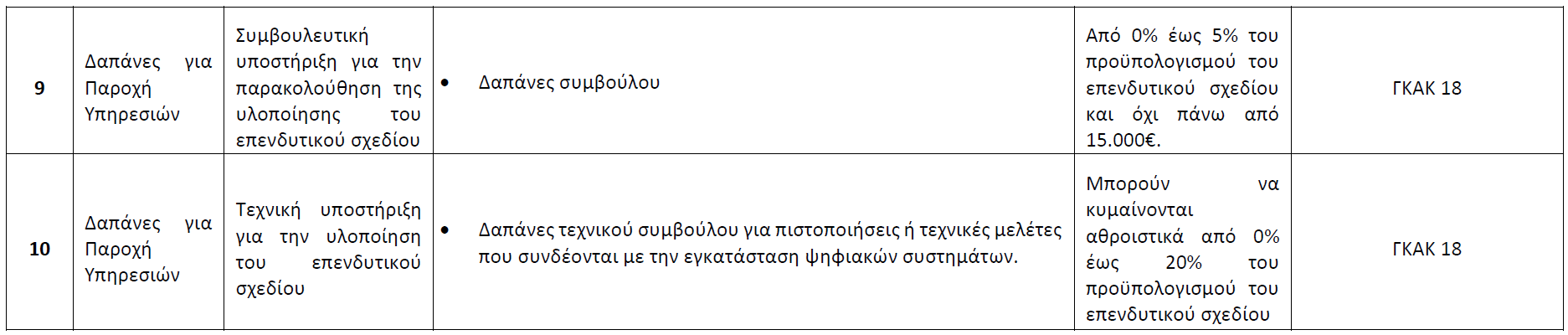
The start date for the eligibility of expenses is the date of publication of the Detailed Call of the Action.
Important dates
Start date for submissions: 23/02/2023 at 12:00
The Action will remain open until the Budget is exhausted.
The funding applications will be evaluated with the direct procedure method (FiFo) in order of priority, according to the date/time of electronic submission (finalisation) in OPSKE.
The start date for the eligibility of expenses is the date of publication of the Detailed Call of the Action.
The maximum duration for completing the physical and financial scope of the investment plan may not exceed fifteen (15) months from the date the Inclusion Decision is issued.
Required supporting documents
15/02/2023
Supporting documents for submitting the application (in Greek)
Useful files
15/02/2023
Call of the Action (in Greek)
15/02/2023
Supporting documents for submitting the application (in Greek)
15/02/2023
Eligible KAD codes (in Greek)
07/11/2022
Pre-announcement of Action 2 – Advanced Digital Transformation of SMEs (in Greek)
Book your free consultation
A 15-minute call is all it takes to find the right programs for your business.
Choose a day & time