
Creation of New Jobs (NJP) for Unemployed Persons in RIS3 Strategy Businesses in the Region of South Aegean
- Status
- Closed
- Opening
- 21-10-2024
- Deadline
- 17-01-2025
- Subsidy
- 100%
- Investment
- +47.200€
The programme
Under the action "Creation of New Jobs (NJP) for Unemployed Persons in RIS3 Strategy Businesses in the Region of South Aegean", support is given to the employment of unemployed persons with higher formal qualifications in enterprises in the Region of South Aegean.
The purpose of the action is the creation of new jobs in full-time employment by hiring unemployed persons registered in the unemployment register of DYPA (formerly OAED), in enterprises of the leading sectors and branches of the regional economy, in line with the regional dimensions of the National Smart Specialisation Strategy. In this way the action helps increase the participation of unemployed persons in the labour market and at the same time supports investment in highly qualified human resources, which in turn improves the competitive position of enterprises and boosts the local labour market.
Who it concerns
Under the Action "Creation of New Jobs (NJP) for Unemployed Persons in RIS3 Strategy Businesses in the Region of South Aegean", support is given to existing enterprises that operate in sectors of the RIS3 strategy.
The above enterprises must be existing small and micro enterprises that:
a) were established by 31/12/2023
b) are substantially active (Main Activity Code or Activity Code with the highest revenue) in an eligible activity KAD code
Basic conditions for participation of the potentially benefiting enterprises
- Only one single funding application per tax identification number (AFM) is submitted to this call.
- It operates exclusively under one of the following forms of enterprises of a corporate/commercial nature [Société Anonyme, Limited Liability Company, General Partnership or Limited Partnership, Private Company (I.K.E.), Sole Proprietorship, Social Cooperative Enterprise of Law 4430/2016 as in force, Cooperative] and keeps single-entry or double-entry books under Law 4308/2014 (books of category B or C respectively).
- They operate, and incur the corresponding expenses, in the Region of South Aegean.
- The lawful operation of the enterprise is proven by holding the appropriate operating licence in force, under the legislation in force, for the KAD codes that concern the business plan. If the licence has not been issued or has expired, the relevant application for its issue/renewal will be provided. Enterprises with activities for which no document of lawful operation is required must provide a Solemn Declaration stating that: "for all the activities of the beneficiary, no operating licence, certificate that the legal conditions for operation are met, notification of start of operation or document of exemption from an operating licence is required", with reference to the relevant provisions of the legislation in force.
- They ensure accessibility of the workplaces for persons with disabilities
- Co-located enterprises, or enterprises which share with another enterprise the premises where the subsidised persons will work (registered office or branch), are not excluded provided they commit in writing that the beneficiaries of the operation will work in the subsidised enterprise. The term co-location means that the enterprise is installed in the same, non-distinct space as another enterprise. If it is found that the term is not kept, the inclusion decision will be revoked and, if an amount has been paid to the beneficiary, it is returned under the procedure for unduly paid amounts.
- When the business of an enterprise is composite and one of its activities is excluded from the programme by this call (e.g. night clubs, telemarketing etc.), the enterprise may submit a funding application provided it submits the Solemn Declaration (Template A of Annex 7) in which it expressly commits that the subsidised beneficiaries of the programme will not be employed in the excluded activity of the subsidised enterprise. If it is found that the term is not kept, the inclusion decision will be revoked and, if an amount has been paid to the beneficiary, it is returned under the procedure for unduly paid amounts.
- The jobs that will be created must be described in detail with the necessary formal qualifications of the unemployed beneficiaries (e.g. desired degrees, specialised knowledge etc.) and must concern only the eligible sector of activity (KAD)
- The duration of the grant is eighteen (18) months plus three (3) months given by the call as time for the enterprise to find and hire the staff, i.e. twenty-one months in total (21 months).
The minimum implementation time of the operation is also set at twelve (12) months, not including the time for finding and hiring staff. The operation will be considered complete once at least twelve (12) months and up to eighteen (18) months of full-time employment have been completed. An implementation period of the operation shorter than twelve (12) months makes the operation incomplete and the inclusion decision is revoked. - The funding application submitted complies with and follows the restrictions on the cumulation of aid laid down by the Regulations that govern it. In particular, the aid is granted under this call with Regulation (EU) 2831/2023 and meets all the conditions of Regulation (EU) 2831/2023 (de minimis))
Not entitled to submit a funding application:
- Public enterprises, public bodies or public organisations and/or their subsidiaries, as well as companies in whose capital or voting rights the local authorities (OTA) & all the above public bodies, individually or jointly, participate directly or indirectly with more than (25%) twenty-five per cent.
- All enterprises, bodies, services and organisations that are governed, as regards the hiring of their staff, by the provisions of Law 2190/94 (Government Gazette 25/A/03.03.1994) and of Law 3812 (Government Gazette 234/A/28.12.2009).
- Enterprises that belong to an already organised uniform network for distributing products or providing services and which, under relevant contracts, use licences to exploit intellectual property rights, usually concerning trade marks or trade names and know-how for the use and distribution of goods or services (e.g. franchising, shop in shop, agency network etc.).
- Enterprises that promote products and provide services by telephone (telemarketing).
- Night clubs.
- Seasonal enterprises, for hiring subsidised persons as their seasonal staff.
- Offshore enterprises, as well as under-establishment enterprises whose owners/shareholders/partners participate in offshore enterprises.
It is noted that the enterprises must be registered in the Register of Beneficial Owners of Article 20 of Law 4557/2018 (A' 139), as in force, before the date the funding application is submitted.
All of the above conditions must be met. Failure to meet one or more of them is a reason for rejecting the funding application.
Program budget
The Public Expenditure of the Action "Creation of New Jobs (NJP) for Unemployed Persons in RIS3 Strategy Businesses in the Region of South Aegean" amounts to €2,000,000 with the possibility of 150% overcommitment and is co-financed by the European Regional Development Fund (ERDF) of the European Union and by National Participation.
Amount of subsidy
The maximum amount an enterprise can receive is approximately €47,200.
The implementation period of the operation is eighteen (18) months plus three (3) months given by the call as time for the enterprise to find and hire the staff, i.e. twenty-one months in total (21 months).
The minimum implementation time of the operation is also set at twelve (12) months, not including the time for finding and hiring staff (an implementation period shorter than twelve (12) months makes the operation incomplete and the inclusion decision is revoked).
Expenses subsidized
The eligible categories of expenses are:
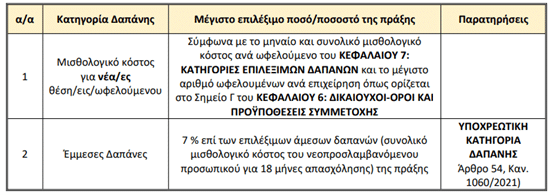
Enterprises are subsidised for every unemployed beneficiary who comes under the Action "Creation of New Jobs (NJP) for Unemployed Persons in RIS3 Strategy Businesses in the Region of South Aegean", from the date of hiring and for a period of eighteen (18) months. The grant covers the total wage cost per beneficiary for one person-month of full-time employment with 25 insured days per month. More specifically, the wage cost may include the actual gross monthly earnings and the insurance and employer contributions.
The table below shows the subsidised monthly wage cost per person-month of full-time employment, depending on the educational level of the beneficiary, as well as the total subsidised wage cost per beneficiary for an employment period of 18 months, including Christmas and Easter bonuses and the holiday allowance. The subsidised budget of the operations must be set according to the amounts shown in the table below.
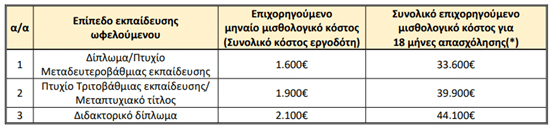
(*) The above amounts concern the maximum total grant and are finalised when the operation is completed, based on the actual figures of the monthly wage cost. Christmas and Easter bonuses and the holiday allowance are taken into account in calculating the total subsidised amount
For the monthly wage cost to be eligible, the employee's net earnings must have been paid, the corresponding insurance contributions (employee and employer) must have been paid over, and the corresponding payroll tax must have been paid over, as well as anything else required under the legislation in force at the time.
If the net (payable) earnings have been paid but the corresponding insurance contributions and the corresponding tax have not been paid over, only the above net earnings can be certified, on condition that the beneficiary has arranged a settlement of its debts and is keeping to it.
The expense of the new job (NJP) is not eligible if the employee is the spouse or a relative up to the 2nd degree (by blood or by marriage) of the employer. In the case of a legal entity, this condition applies to all partners/shareholders.
The expense of the new job may in no case concern a partner of the subsidised enterprise (with the exception of partners of a Social Cooperative Enterprise (KOINSEP)).
Please note that:
- On the date the employee is hired, the newly hired person's unemployment card from DYPA must be in force, or a certificate from a DYPA service that the person is registered in the registers of the unemployed. This category also includes those professionals, holders of a licence to practise a profession, who do not practise a liberal or other profession on the date of hiring.
- The employees must be employed in the enterprise in full-time dependent employment (salaried work).
Important dates
Start of submission of applications: 21/10/2024 at 13:00
End of submission of applications: 17/01/2025 at 15:00
If the budget, increased by 100%, is exhausted before the above date, submissions for the Region are locked automatically and it is therefore not possible to finalise electronic funding applications that are in "Draft" status.
The funding applications will be evaluated in order of priority, according to the date/time of electronic submission (finalisation) in OPSKE.
The start date for the eligibility of expenses is the date of publication of the call of the Action
The implementation period of the operations is eighteen (18) months plus three (3) months given by the call as time for the enterprise to find and hire the staff, i.e. twenty-one months in total (21 months)
Supporting documents required for submission
Useful files
17/09/2024
17/09/2024
Book your free consultation
A 15-minute call is all it takes to find the right programs for your business.
Choose a day & time