
Priority Application of Mainly Non-Technological Innovations by Enterprises under the Regional Dimension of the National Smart Specialisation Strategy
- Status
- Closed
- Opening
- 25-09-2024
- Deadline
- 05-12-2024
- Subsidy
- 70%
- Investment
- +60.000-400.000€
The programme
The Action "Priority Application of Mainly Non-Technological Innovations by Enterprises under the Regional Dimension of the National Smart Specialisation Strategy" includes innovative interventions for reorganising the production and/or administrative functions of the Region's enterprises, such as changing the production process (production lines, reorganising the sales system and/or the internal operation of the enterprises by changing the organisation chart and the operating procedures of the enterprise in all its organisational units).
Under the "North Aegean" Programme of ESPA 2021-2027 and Priority 1: "Transformation of the Region's economy, by increasing the size and productivity of enterprises, mainly also through smart specialisation (ERDF)", the aim is to strengthen the competitiveness of the enterprises of the Region of North Aegean, with continuous adaptation to the new international conditions of production and trade, and to transform them through the adoption of more sustainable, efficient and green business models.
This Action does not refer to the development of technological innovation but promotes the following:
- Organisational innovation, that is, "the implementation of a new organisational method in the enterprise's business practices (including knowledge management), in the organisation of the workplace or in the external relations of the enterprise, which has not been used by the enterprise in the past".
This innovation must be the result of strategic decisions by the enterprise's management. Mergers or acquisitions are excluded, even if they are carried out for the first time.
The following organisational methods are examined:
- New business practices for organisational procedures (e.g. supply chain management, business reorganisation, knowledge management, lean production, quality management etc.)
- New methods of organising work and decision-making (first-time use of e.g. a new system for allocating employees' responsibilities, teamwork, decentralisation, merging or splitting of departments, education and training systems etc.)
- New methods of organising external relations with other enterprises or public bodies (first-time implementation of e.g. collaborations, partnerships, outsourcing or subcontracting etc.)
- Process innovation, that is, when a company develops a method for creating its product or service. This type of innovation is often less visible to consumers or customers. Nevertheless, it can make a big difference for the companies that use it. Process innovation often leads to faster production, greater efficiency and less waste of time and resources. It may be more evident in manufacturing industries, but in any case companies that provide a service can also innovate in their processes.
The proposed interventions of this kind must be included in a relevant study that diagnoses the needs and defines the expected results.
Who it concerns
In the Action " Priority Application of Mainly Non-Technological Innovations by Enterprises under the Regional Dimension of the National Smart Specialisation Strategy ", the beneficiaries that may receive public funding under this Action are existing medium-sized, small and micro enterprises
Existing enterprises are those that have at least two (2) full closed financial years, 2022-2023, before the date the funding application is submitted electronically.
A closed full financial year means a year for which the final financial result has been determined in the accounts and the proper tax forms (e.g. forms E3 & N) have been filed with AADE (the tax authority), and which lasts 12 months.
The main conditions for participation of the potentially benefiting enterprises are the following:
- They must submit one single funding application per tax identification number (AFM).
- They must operate, or will operate, in Greek territory and make the investment exclusively within the Region of North Aegean.
- They must have closed at least two (2) full financial years (2022-2023) before the date the funding application is submitted electronically.
- The enterprise must have at least one (1) AWU of salaried employment in the year before the year the funding application is submitted.
- The proposed investment plan must concern at least one of the eligible KAD codes, in which the beneficiaries must operate substantially in the closed financial year 2023 (main KAD code or KAD code with the highest revenue).
- The subsidised budget of the investment plan must not exceed three times the highest turnover achieved in one of the two full closed financial years before the date the funding application is submitted (2022-2023), and must be higher than the minimum limit set
- They must provide evidence of having secured the Private Contribution to the proposed investment plan at a rate of at least 30% of the Total Budget
- They must have the status of a Micro or Small or Medium-Sized Enterprise
- They must operate legally, holding the appropriate licensing document under the legislation in force for their aided activity (e.g. operating licence, solemn declaration of start of operation, exemption from an operating licence, notification of start of operation etc.). If the licence has not been issued or has expired, the relevant application for its issue/renewal must be submitted.
Enterprises with activities for which no operating licence is required must submit a Solemn Declaration by the Legal Representative confirming that no operating licence needs to be issued, or a document of exemption from the relevant obligation, with relevant documentation.
- They must operate exclusively under one of the following forms of enterprise: enterprises of a corporate/commercial nature, i.e. société anonyme (A.E.), limited liability company (E.P.E.), general partnership (O.E.) or limited partnership (E.E.), private company (I.K.E.), sole proprietorships and Social Cooperative Enterprises of Law 4430/2016 as in force, Shipping Company of Pleasure Boats (NEPA), Agricultural Cooperatives
- They must keep single-entry or double-entry books under Law 4308/2014, as in force.
- They must be registered in the Register of Beneficial Owners of Article 20 of Law 4557/2018 (A' 139), as in force.
- They must not be in bankruptcy, liquidation or compulsory administration, and the enterprise's creditors must not have filed an application for restructuring
- They must meet the conditions for applying Regulation (EU) 2831/2023 (De Minimis) (OJ EL L 15.12.2023), on which the Action is based. More specifically, the total amount of de minimis aid granted per Member State to a single undertaking does not exceed €300,000 over the last three years (three years calculated on a rolling calendar basis).
- They must not have completed the physical scope of the investment, or implemented it in full, before the funding application is submitted.
- They must commit that the expenses included in this funding application have not been funded and are not included in another programme funded from national or Community resources.
- They must commit that the expenses included in this funding application, if approved, will not be submitted to another programme funded from national or Community resources.
- The place where the investment is implemented must not be the beneficiary's home (main or secondary).
- They must commit that, until the investment is completed and depending on the type and nature of the proposed Operation, they will see to the appropriate interventions so that persons with disabilities have access to the building infrastructure, the services and the electronic environments, in accordance with the institutional framework in force
- They must submit a funding application electronically, accompanied by all the necessary data, supporting documents and forms
All of the above conditions must be met. Failure to meet one or more of them is a ground for exclusion of the investment plan and therefore a reason for rejection
It is noted that:
- Co-location of enterprises is not allowed, so that the fixed assets of the aided investment cannot be used by another enterprise. Co-location means that the aided enterprise is installed in the same, non-distinct space as another enterprise (for example, sharing common utility networks). If co-location of enterprises is found, where the fixed assets of the aided investment can be exploited by another enterprise, the inclusion decision will be revoked.
The following are not entitled to submit a funding application:
- Financial and insurance institutions, public enterprises, public bodies or public organisations and/or their subsidiaries, Legal Entities under Public Law (NPDD), as well as companies in whose capital or voting rights local authorities (OTA) and all the above public bodies participate, directly or indirectly, individually or jointly, with more than twenty-five per cent (25%) (and enterprises treated as such, as main partners). In addition, sports clubs, associations and sports sociétés anonymes of any kind are not entitled to submit a funding application, nor are enterprises related to the above categories in any way (for example: parent, subsidiary, linked, partner, common ownership/management through natural persons etc.).
- Offshore companies
Program budget
The Public Expenditure of the Action amounts to €7,000,000, with a possible overcommitment of 200% and is co-financed by the European Regional Development Fund (ERDF) of the European Union and by National Participation.
Amount of subsidy
The subsidised budget of each investment plan ranges from €60,000 to €400,000.
The subsidised budget may not exceed three times the highest turnover achieved in one of the two full closed financial years before the date the funding application is submitted (2022-2023), with a ceiling of €400,000.
The public expenditure for all investment plans amounts to 50% of the subsidised budget, while the remaining amount is covered by private contribution.
Expenses subsidized
The main expense categories covered by the Action are the following:
- Staff
- Equipment, Means of Transport & Instruments
- Buildings, Land, Installations & Surrounding Area
- Provision of Services
- Software
- Indirect Expenses
When forming the proposed subsidised budget of the investment plan, the requested expenses must be linked to the following categories of eligible expenses:
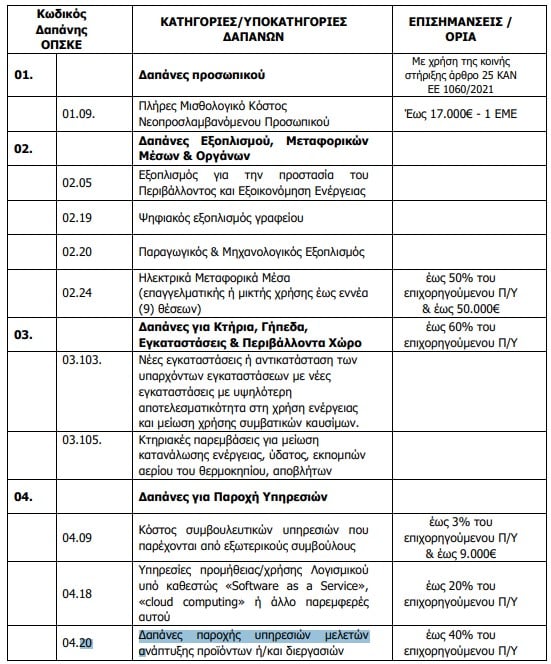
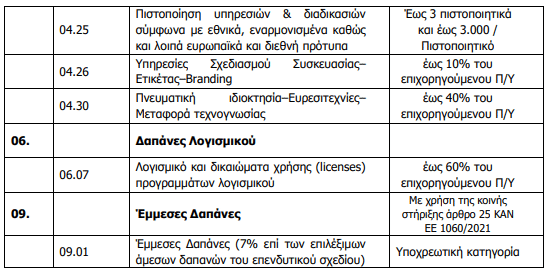
The start date for the eligibility of expenses is the date of publication of the call of the Action
Important dates
Start of applications: 25/09/2024 at 13:00
End of applications: 05/12/2024 at 15:00
The start date for the eligibility of expenses is the date of publication of the call of the Action
Duration of Implementation of the Investment Plan: The deadline for completing the funded investments may not exceed twenty-four (24) months from the date the funding application is approved.
Useful files
20/09/2024
04/10/2024
Book your free consultation
A 15-minute call is all it takes to find the right programs for your business.
Choose a day & time