
Green Transformation of SMEs
- Status
- Closed
- Opening
- 22-03-2023
- Deadline
- 10-10-2023
- Subsidy
- 25%–50%
- Investment
- +200.001 - 1.000.000
The programme
This Action 1 – Green Transformation of SMEs encourages investment plans that aim to use and develop modern technologies and to upgrade the products produced and/or the services provided and the enterprises' activities in general. It favours actions that make use of modern technologies, infrastructure and best practices in energy upgrading, the circular economy and the adoption of clean energy sources (e.g. use of RES systems).
Who it concerns
Proposals for the Green Transformation of SMEs Action may be submitted by existing medium-sized, small and micro enterprises which, before the date the funding application is submitted electronically:
- Have at least one (1) full closed financial year
- Operate substantially (main activity code or the activity code with the highest revenue) in one (1) eligible activity KAD code included in Annex III. ELIGIBLE ACTIVITIES (KAD), AID SCHEME of REG. (EU) 1407/2013 (DE MINIMIS) or in Annex III, AID SCHEME of REG. (EU) 651/2014
- Hold the eligible investment KAD code(s) of Annex III. ELIGIBLE ACTIVITIES (KAD), AID SCHEME OF REG. (EU) 1407/2013 (DE MINIMIS) or of Annex III, AID SCHEME OF REG. (EU) 651/2014
- Have at least three (3) AWU of salaried employment, full-time or part-time, in the calendar year before the funding application is submitted. This will be confirmed on the basis of the declared data kept for the enterprise in the ERGANI information system.
In addition, they must:
- Declare, as the place(s) where the actions of this Action are implemented, exclusively one category of Region. It is clarified that the enterprise may incur expenses at its registered office and/or at its branches, provided that all implementation sites belong to the same category of region and have the same aid intensity.
- Work on the investment plan must not have started before the funding application is submitted. Otherwise:
- If the funding application was submitted under the funding scheme of Reg. (EU) 1407/2013 (De minimis), the expense is considered non-eligible and is therefore rejected.
- If the funding application was submitted under the funding scheme of Reg. (EU) 651/2014 (GBER), the whole investment plan becomes non-eligible for funding.
- They must operate legally, holding the appropriate licensing document under the legislation in force and for the activity they carry out (e.g. operating licence, solemn declaration of start of operation, exemption from an operating licence, notification of start of operation etc.). If the licence has not been issued or has expired, the relevant application for its issue/renewal must be submitted.
- They must not be in bankruptcy, liquidation or compulsory administration, and the enterprise's creditors must not have filed an application for restructuring.
- No recovery of state aid must be pending against them following a decision of the European Commission declaring an aid illegal and incompatible with the internal market.
- If the funding application was submitted under the funding scheme of Reg. (EU) 651/2014 (GBER):
- It must have an incentive effect and therefore work on the investment plan must not have started before the funding application is submitted. Otherwise the whole investment plan becomes non-eligible for funding.
- Investment plans must have the character of an initial investment
- The financial contribution of the aid beneficiary must be at least 25% of the eligible expenses, either through own resources or through external financing, in a form that contains no state support, for the expenses subsidised under Article 14 of Reg. (EU) 651/2014; otherwise the funding application will be rejected
- The enterprise must not have, in the two years before the aid application, relocated to the establishment where the initial investment will take place for which the aid is requested, and must commit not to do so within a maximum period of two years after completing the initial investment for which the aid is requested
The following are not entitled to submit a funding application:
- Financial and insurance institutions, public bodies or public organisations and/or their subsidiaries, public enterprises, Legal Entities under Public Law (NPDD), as well as companies in whose capital or voting rights local authorities (OTA) and all the above public bodies participate, directly or indirectly, individually or jointly, with more than twenty-five per cent (25%) (and enterprises treated as such, as main partners). In addition, sports clubs, associations and sports sociétés anonymes of any kind are not entitled to submit a funding application, nor are enterprises related to the above categories in any way (for example: parent, subsidiary, linked, partner, common ownership/management through natural persons etc.)
- All offshore companies
- Co-location of enterprises is not allowed, so that the equipment of the aided investment cannot be used by another enterprise. Co-location means that the aided enterprise is installed in the same, non-distinct space as another enterprise.
If co-location of enterprises is found, where the equipment of the aided investment can be used by another enterprise, the inclusion decision will be revoked. - Enterprises are not accepted if their place of implementation is the Beneficiary's home (main or secondary).
Program budget
The total budget of the Green Transformation of SMEs Action amounts to €300,000,000 (Public Expenditure).
The subsidised budget of each investment plan ranges from €200,001 up to €1,000,000.
The subsidised budget of the investment plan may not exceed twice the highest turnover achieved in one of the three (or fewer, if the enterprise does not have three) financial periods preceding the submission of the funding application, with a ceiling of €1,000,000.
The budget amounts granted under Reg. (EU) 651/2014 may not exceed the limit of €150,000,000 per year.
The Action is co-financed by the European Union, specifically by the European Regional Development Fund (ERDF), and by the Greek State.
Amount of subsidy
Under this Green Transformation of SMEs Action, there is a choice between the following aid funding schemes:
- Reg. (EU) 1407/2013 (De Minimis rule)
- Reg. (EU) 651/2014 (GBER), Art. 14, 18, 19 and 41.
When submitting the application, the enterprise must choose one of the two aid funding schemes. Choosing a scheme is mandatory for submitting the Funding Application and cannot be changed at a later stage.
The maximum grant is €500,000 per tax identification number (AFM).
The grant rate may be increased by 10% if GREEN Transition expenses amounting to 20% of the eligible budget of the investment plan are included when the investment plan is approved. This increased grant rate will remain fixed during the stage of interim verifications and payments.
This increase is confirmed provided that GREEN Transition expenses amounting to at least 20% of the total eligible budget of the investment plan are incurred and certified at the final verification stage.
If the investment plan falls under Regulation (EU) 651/2014, it must be shown when the funding application is submitted that the Private Contribution (own funds and/or external financing) to the proposed budget of the investment plan is at least twenty-five per cent (25%) of it, and it must contain no state support.
Aid rates
The aid rates of the investment plans and the private contribution of the aid beneficiary, for all the aided expenses of the investment plans, are as follows, as the case may be:
- Where the aid follows the framework of Regulation (EU) 1407/2013 (De minimis), its intensity is set according to the following Table.
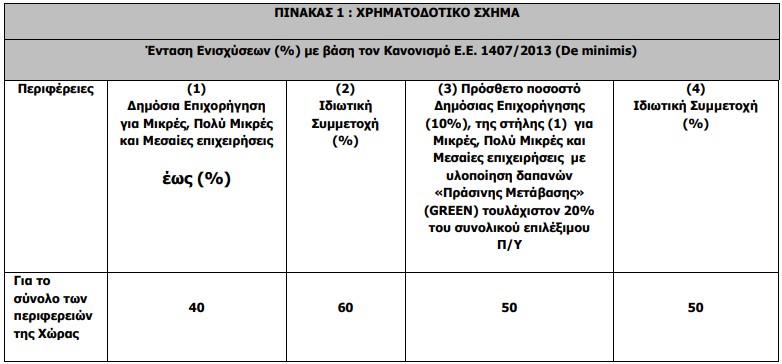
It is noted that for Funding Applications based on De Minimis, the total amount of de minimis aid received by a single undertaking must not exceed €200,000 (or €100,000 for the sector of road freight transport on behalf of third parties) within a three-year period (the current financial year and the two (2) previous financial years) before the time the legal right to the aid is granted.
- Where the aid follows the framework of Regulation (EU) 651/2014 (GBER), Articles 14, 18, 19 and 41, its intensity is set according to the following Tables:
It is noted that: the aid intensity, expressed as gross grant equivalent, does not exceed the maximum aid intensity set in the regional aid map 2022-2027, as in force. - For the expenses aided under Article 14 of the GBER, the intensities are as follows:
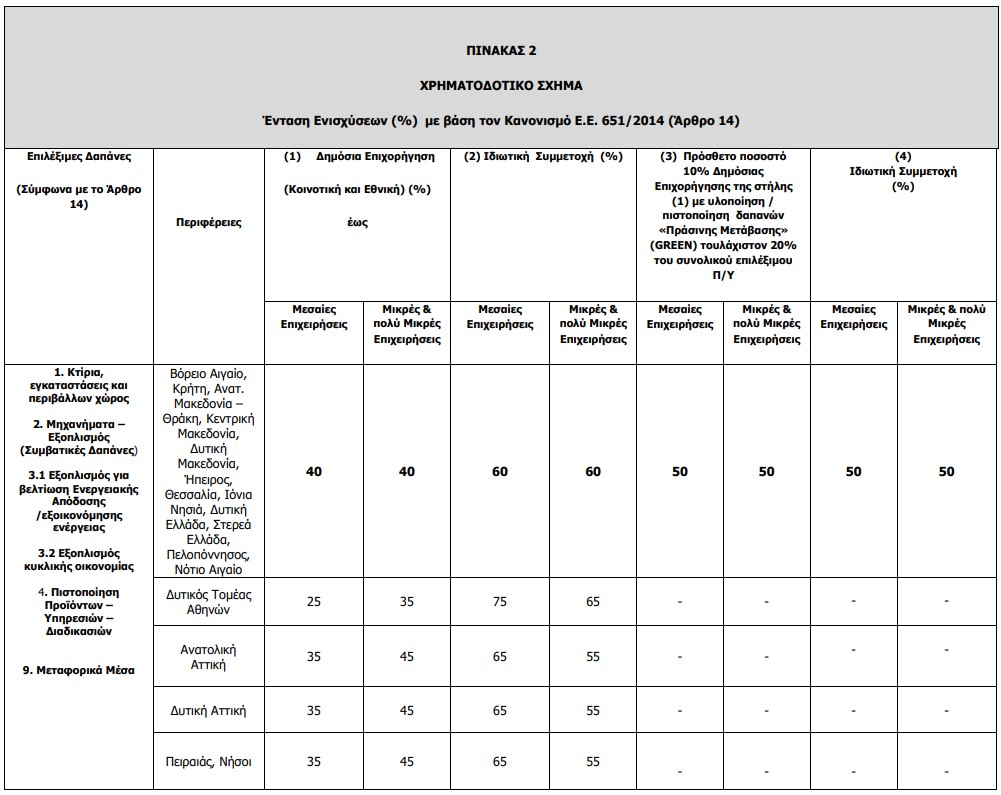
- For the expenses aided under Article 18 of the GBER, the intensities are as follows:
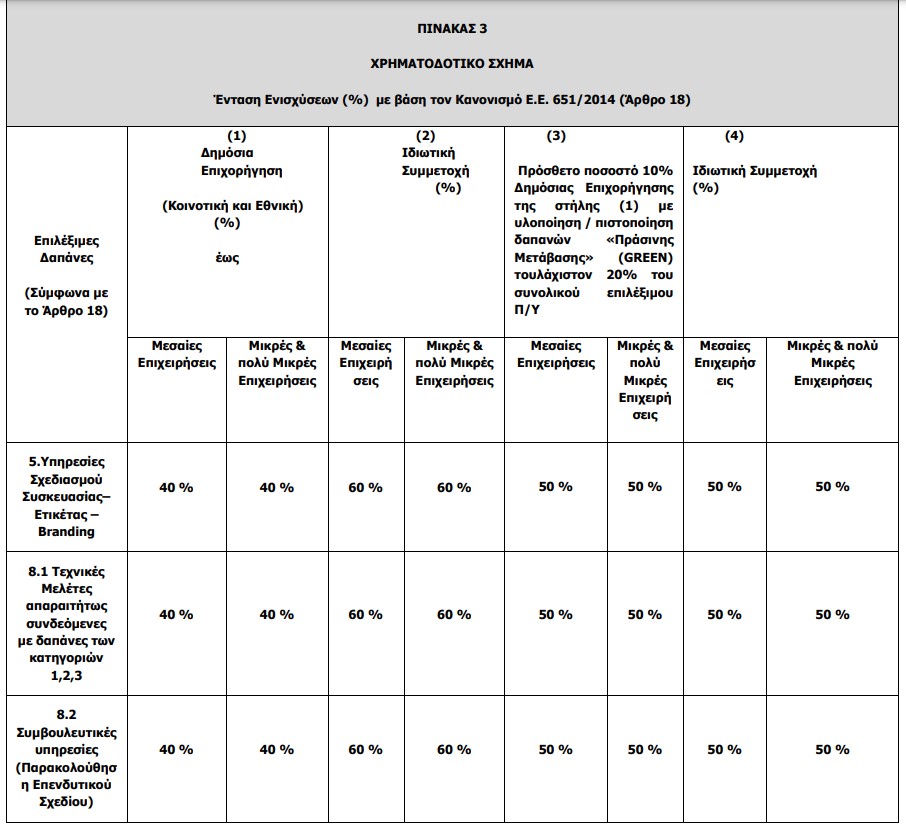
- For the expenses aided under Article 19 of the GBER, the intensities are as follows:
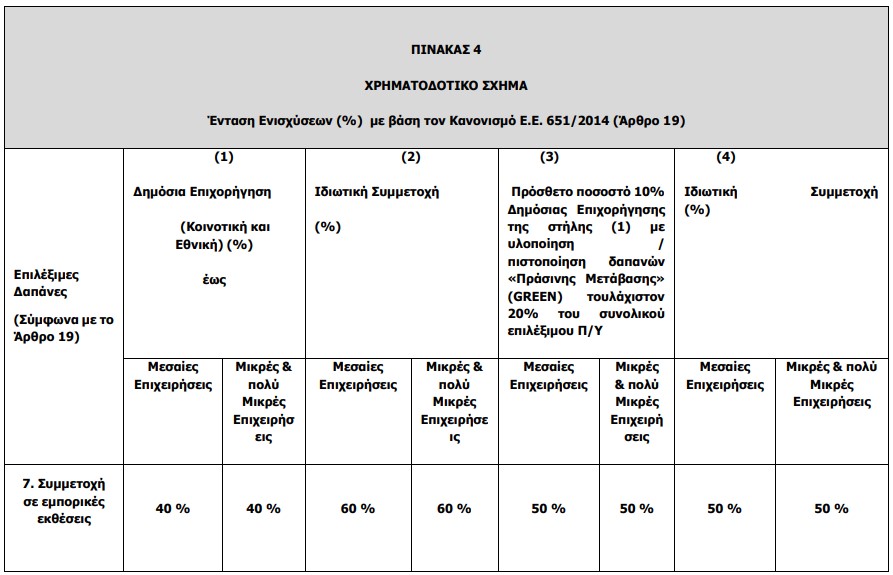
- For the expenses aided under Article 41 of the GBER, the intensities are as follows:
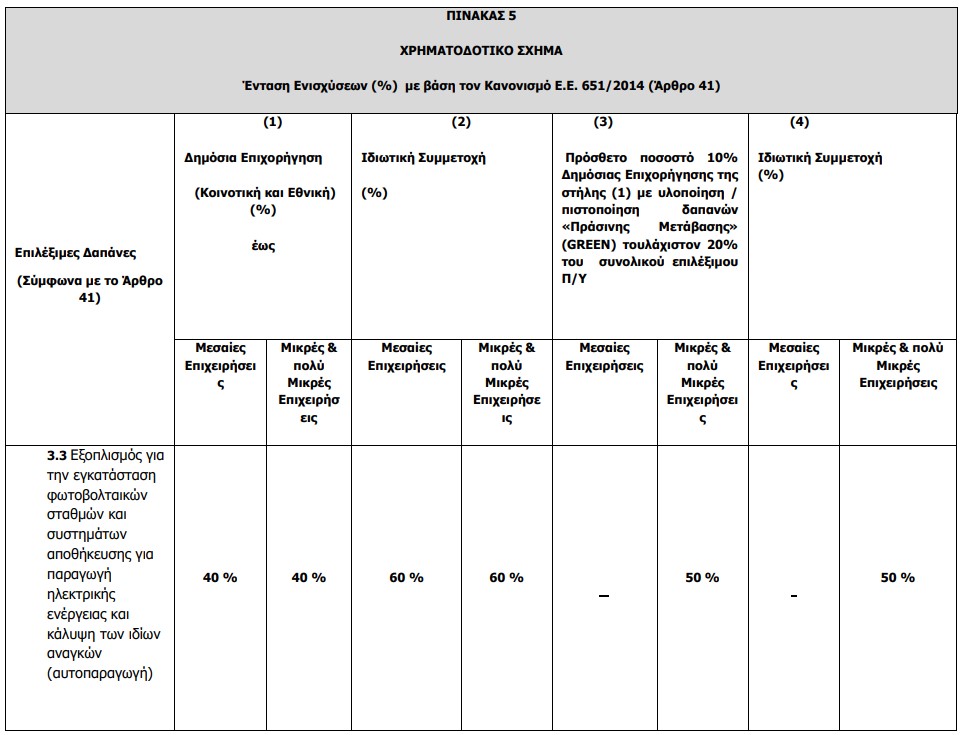
Expenses subsidized
To form the budget of the investment plans to be funded under the Action, the eligible main expense categories are the following:
I. Buildings, installations and surrounding area
II. Supply and installation of new modern machinery and of equipment in general, necessary for the operation of the enterprise and for carrying out its economic activity (Conventional Expenses).
III. Supply and installation of equipment to improve energy efficiency – energy saving and environmental protection ("Green Transition"/GREEN Expenses).
IV. Certification of products, services and processes according to national, harmonised and voluntary standards of European countries and/or countries outside the EU (standards of the countries of destination).
In addition, expenses are aided for: a) wage cost of newly hired staff, b) technical studies, c) digital promotion, d) means of transport and e) consultants' services for monitoring the investment plan, f) participation in trade fairs, g) wage cost of existing staff, h) indirect expenses.
In detail, the categories of eligible expenses are the following:

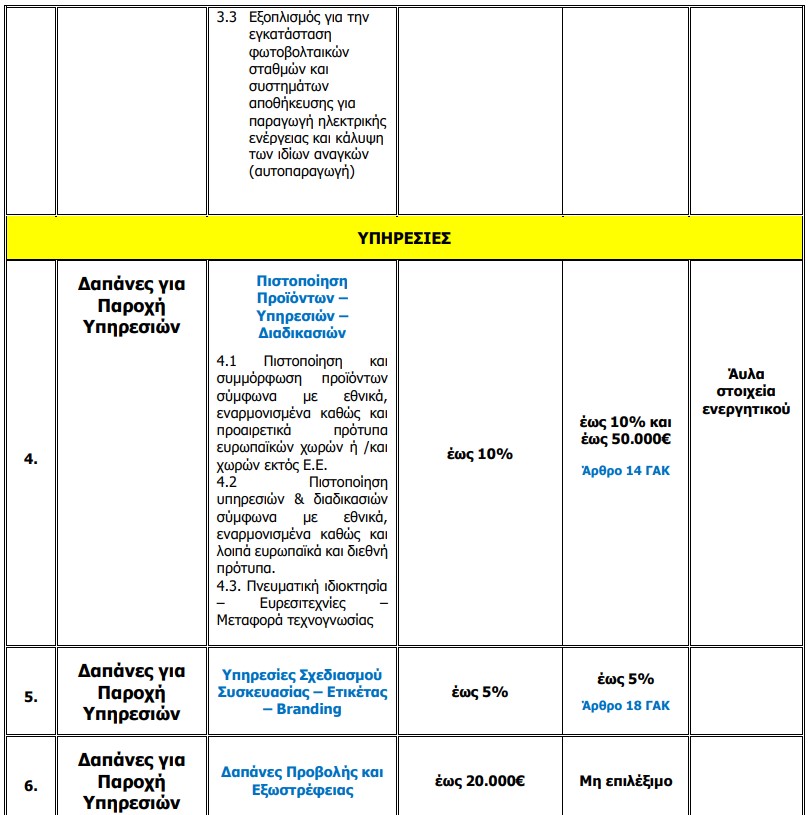
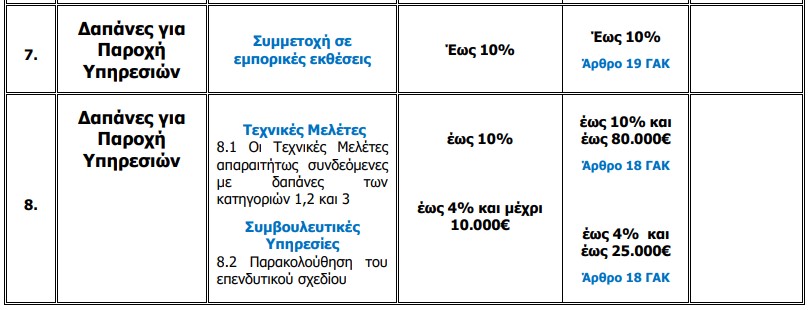
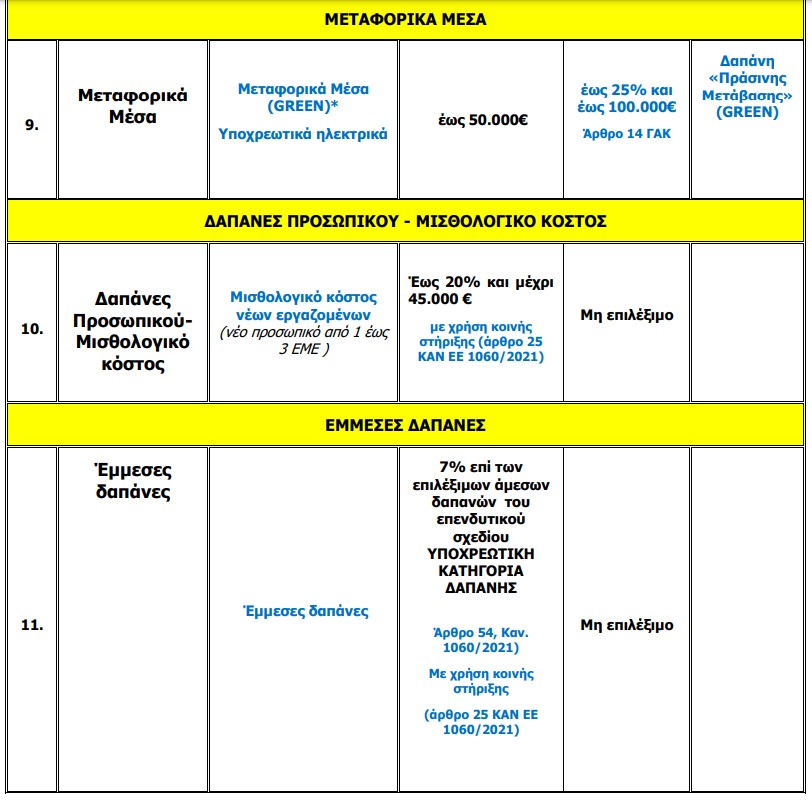
The start date for the eligibility of expenses is the date the funding application is submitted.
If an expense is incurred before the date the application is submitted:
- If the funding application was submitted under the funding scheme of Reg. (EU) 1407/2013 (de minimis), the expense is considered non-eligible and is therefore rejected.
- If the funding application was submitted under the funding scheme of Reg. (EU) 651/2014 (GBER), the whole investment plan becomes non-eligible for funding.
Important dates
Start date of submissions: 22/03/2023 at 12:00
The Action will remain open until the budget is exhausted.
Funding applications will be evaluated by the direct procedure method (FiFo), in order of priority, according to the date/time of electronic submission (finalisation) in OPSKE.
The start date for the eligibility of expenses is the date the funding application is submitted.
- If the funding application was submitted under the funding scheme of Reg. (EU) 1407/2013 (De minimis), the expense is considered non-eligible and is therefore rejected.
- If the funding application was submitted under the funding scheme of Reg. (EU) 651/2014 (GBER), the whole investment plan becomes non-eligible for funding
The maximum time for completing the physical and financial scope of the investment plan may not exceed twenty-four (24) months from the date the Inclusion Decision is issued.
Requests for an extension of implementation may be submitted with documented justification, for a maximum of up to six (6) months from the final deadline of twenty-four (24) months.
Supporting documents required for submission
07/03/2023
Supporting documents for the application (in Greek)
Funding applications will be submitted only electronically, without submitting a physical file of supporting documents, through the Integrated State Aid Management Information System (OPSKE).
The applications will be evaluated by the direct procedure method (FiFo) and the investment plans will be examined in the order in which they are submitted, until the budget of the Action is exhausted and in any case until the regulation expires. First the conditions for participation will be checked and then the eligible plans will be scored on criteria that will be set out in the detailed Call and will relate to:
- the adequacy and availability of own funds
- existing employment
- the change in turnover, exports and operating profitability
- the size of the subsidised budget of the proposed investment in relation to the turnover of the enterprise (investments with low risk and low uncertainty of implementation are favoured)
- the place where the investment is implemented (investments to be implemented in special areas, i.e. mountainous, disadvantaged or island areas, are favoured)
- meeting the requirements of initial investment and incentive effect
- the description, the timetable and the maturity of the investment plan
- the relevance of the enterprise's investment plan to the National Smart Specialisation Strategy 2021-2027
You can also find information in the action Green Productive Investment.
The minimum qualifying score is 45.
Useful files
22/03/2023 1st amendment of the Call of the "Green Transformation of SMEs" Action (in Greek)
07/03/2023 Call of the "Green Transformation of SMEs" Action (in Greek)
07/03/2023 Supporting documents for the application (in Greek)
19/12/2022 Pre-publication of the "Green Transformation of SMEs" Action (in Greek)
Book your free consultation
A 15-minute call is all it takes to find the right programs for your business.
Choose a day & time