
Young farmers: Subsidies from 30,000 to 42,500 euros – What the Action “Installation of Young Farmers” provides
From 30,000 to 42,500 euros is the support that will be given to new farmers, who will join the new program, the publication of which is expected after the end of IACS applications in 2024. According to the pre-publication of the new call for the submission of support applications for inclusion in intervention P3-75.1 “Settlement of Young Farmers” of the Strategic Plan of the Common Agricultural Policy (SS CAP) of Greece 2023-2027″, the provision and cut-off financial support to young people who have not exceeded 41 years of age is provided for entering and staying in agricultural employment and their first establishment, as leaders, in agricultural holdings.
It should be noted that, the application for support will be drawn up on the basis of the accepted Single Application for Aid (EAE) with which basic aid is requested, linked or not, in the year 2024.
How to calculate the amount of support for the Action “Installation of Young Farmers”
The amount of support that will be given is provided in the form of non-refundable aid capital (a lump sum), not linked to specific costs but to the achievement of specific quantitative goals. However, the implementation of investmentsn.
is gradedThus, the amount of support is structured as follows:
A basic support amount of 30,000 euros is provided, on which the following supplements are calculated:
a) 2,500 euros, if the area of permanent residence of the farm heads is located in mountainous or disadvantaged areas or on small islands (islands with a population of up to 3,100 inhabitants) and in regional units with a population density less than or equal to 35 inhabitants per square kilometer based on the 2021 population census) or a combination of these categories of areas
b) 10,000 euros, if the main direction of the agricultural holding at the completion of the business plan is poultry farming
Consequently, the amount of support can be configured from 30,000 euros to 42,500 euros.
The financial support is paid in two installments. The first installment is paid when the new farmer joins the measure and corresponds to 70% of the total support. The remaining 30% is paid after the certification of the completion of the investment project.
Candidates submit a standardized business plan for the development of their agricultural holding that includes the stages of implementation of the relevant actions. The duration of the implementation of the business plan cannot be less than three years and more than four.
Standard rates
The agricultural holding must be included in its entirety in an acceptable EAE for the year 2024 with which the applicant is applying for basic (linked or unlinked) aid.
The size of production capacity (expressed as standard output) must be greater than or equal to:
- 12,000 euros for the mainland, Crete and Evia or
- 10,000 euros for islands with a population greater than 3,100 inhabitants except Crete and Evia or
- 8,000 euros for islands with a population less than or equal to 3,100 inhabitants
It should be noted that, by way of derogation, taking into account the significant environmental contribution of beekeeping and the EU priorities for pollinators (Green Deal, Farm-Plate and Biodiversity Strategies) regardless of the place of establishment of the new farmer, farms that utilize and declare in the above EAE at least 103 hives for the mainland Crete and Evia, 74 for the country’s islands with less than 3,100 inhabitants and 92 for the rest of the country’s islands.
The standard performance of the farm does not include the standard performance relating to:
a) Pastures
b) Forest trees that do not produce edible fruit
c) Nurseries
d) Areas in fallow
e) Land that is not included in cultivation activity
f) Lands with RES
g) Prey
h) Game birds
i) Mushrooms not grown in intensive culture in chambers
j) Ineligible lands
Also, the standard yield of intersown crops is not counted in the calculation of standard yield.
In the initial state:
- For mainland Crete and Evia, a standard return of at least 10,000 euros must come from productive plantations or annual crops
- For the country’s islands with a population of more than 3,100 inhabitants, a standard return of at least 8,300 euros must come from productive plantations or annual crops
- For the country’s islands with a population of less than or equal to 3,100 inhabitants, a standard return of at least 6,700 euros must come from productive plantations or annual crops
On completion:
- For mainland Crete and Evia, a typical yield of at least 12,000 euros must come from productive plantations or annual crops
- For the islands of the country with a population of more than 3,100 inhabitants, a standard yield of at least 7,500 euros must come from productive plantations or annual crops
- For the country’s islands with a population of less than or equal to 3,100 inhabitants, a standard yield of at least 6,000 euros must come from productive plantations or annual crops
In calculating the standard yield of crops of permanent young plantations (eg young trees, vineyards) 50% of the standard yield used for plantations that have entered production is used.
Who can apply for support
Natural persons and legal entities have the right to submit a support application.
In particular, for natural persons, on the date of submission of the support application, the head of the holding must meet the following conditions:
- Has reached the age of majority and has not exceeded his/her 41st year of age
- He is a permanent resident in one of the areas of application of the measure
- He is the legal owner of an economically independent agricultural and livestock holding (own livestock) and is legally and financially responsible for its normal operation
- Settles for the first time on the farm, i.e. registers in the Register of Farmers and Agricultural Holdings (MAAE) as a professional farmer new entrant to the agricultural sector during the eighteen months preceding the date of submission of the support application
- Submits an acceptable EAE for the year 2024 with which basic aid is requested, linked or not
- He has at least knowledge level 4, that is, he is a graduate of a vocational school or high school, or he has a knowledge level of level 2, that is, a high school diploma and, at the same time, education in a geotechnical field lasting at least 150 hours that is not part of a certificate or diploma (non-formal education – certificate from the competent authority)
- Has not practiced agricultural professional activity at least during the last 5 years before the date of first establishment
- During the last four years before the year preceding that of the reference year (2019 – 2022), have not submitted an IASC declaration with an average standard return exceeding 12,000 euros on the mainland, Crete and Evia and 10,000 euros on the islands other than Crete and Evia
- He does not have permanent non-agricultural employment, dependent or non-dependent, or, if he has, he undertakes to stop it after the announcement of the examination results of his application (if he is deemed eligible) and before joining the measure
- There has not previously been a beneficiary of measures for young farmers of the RDP 2014 – 2022, RDP 2007 – 2013 and EPAA-AY 2000 – 2006
- He does not have a spouse who: 4.1.11.1. It has submitted an IASC declaration in the year 2024 or
- In the years 2022 and/or 2023 he has submitted an IASC declaration with a standard return that exceeds 12,000 euros on the mainland Crete and Evia and 10,000 euros on the islands other than Crete and Evia or
- She is a professional farmer, based on a certificate or cross-check from the MAAE. Spouses of professional fishing farmers are excluded
- If he has the status of a student to have completed the number of prescribed years of study for each faculty
- To have fulfilled his military obligations up to 9 months after the end of the deadline for submitting the support application or to have been exempted from them
- If he receives a disability allowance with a disability rate equal to or greater than 67% to be judged by the competent body (KEPA) as fit for work (livelihood occupation)
Which areas are included – The exceptions
The intervention Π3-75.1 of the Strategic Plan of the Common Agricultural Policy (SS CAP) 2023-2027 is applied in areas where agricultural activity is important, i.e. in the whole country with the following exceptions:
In PE of Thessaloniki, intervention Π3-75.1 does not apply to the Municipal Community of the 5th District of Thessaloniki.
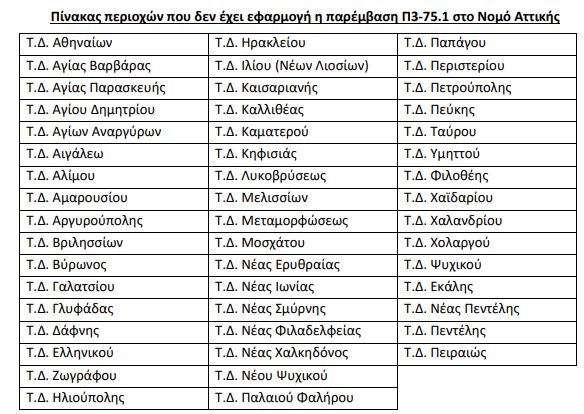
In PE Attica, intervention Π3-75.1 applies to Island Municipalities as well as to Municipalities and Communities with agricultural activity, i.e. the areas that have a degree of Urbanization 2 and 3 (intermediate density populated and sparsely populated areas) and belong respectively to intermediate and mainly rural areas of Attica, excluding the pre-eminent urban fabric of Attica, according to the table below:
Source: ot.gr