
Support for Productive Investments – Adaptation / Modernisation and Recovery (Attica)
- Status
- Expected
- Opening
- Not announced
- Deadline
- Not announced
- Subsidy
- 50%–65%
- Investment
- +65000000
Support for Productive Investments – Adaptation / Modernisation and Recovery
The Action aims to support the activities of the priority sectors of the National Smart Specialisation Strategy, as these have been specified for the Region of Attica (Regional Dimension), by supporting investment plans of existing micro and small enterprises of the Region of Attica for their technological transformation, extroversion, the upgrading of their products / services / activities, and the improvement and modernisation of their production methods, by using and developing modern technologies, methods and tools, as well as infrastructure and best practices in energy upgrading and the circular economy.
The Action falls under Specific Objective 1.3: "Enhancing sustainable growth and competitiveness of SMEs and job creation in SMEs, including by productive investments (ERDF)" of the "Attica" Programme 2021-2027.
This Action seeks:
- To strengthen the competitiveness and resilience of the micro and small enterprises of Attica and to support them in modernising and in reducing their environmental footprint, through the introduction of technological and organisational innovation
- To strengthen the competitiveness and extroversion of enterprises
- The production of new innovative products/services and/or the introduction of modern production methods and processes
- An increase in employment
Support for Productive Investments – Adaptation / Modernisation and Recovery - Who it concerns
The beneficiaries that may receive public funding under the Action are existing Micro and Small Enterprises whose investment plan is demonstrably linked to at least one Smart Specialisation Priority of the Region of Attica.
Conditions for participation
The following conditions must all apply to the potential beneficiaries before the date the funding application is submitted electronically:
- They must have at least two (2) full closed financial years (calendar years n-1, n-2) before the date the funding application is submitted electronically (year n).
- They must operate substantially (Main Activity Code or Activity Code with the highest gross revenue) for two (2) financial years in one (1) eligible activity KAD code, specifically: a. for the years (n-1) and (n-2), if the substantial activity derives from the enterprise's Main Activity Code, or b. for the years (n-2) and (n-3), if the substantial activity derives from the Activity Code with the highest gross revenue.
- The proposed investment plan must concern at least one eligible investment KAD code.
- They must have at least two (2) AWU of salaried employment in the calendar year (n-1) before the date the funding application is submitted (year n). This will be confirmed on the basis of the declared data kept for the enterprise in the ERGANI information system.
- The subsidised budget of the investment plan may not exceed twice the highest turnover [code (500) of tax form E3] achieved in one of the two full closed financial years [for which the proper tax forms have been filed with AADE, i.e. 01-01-2022 to 31-12-2022 (year n-3) and 01-01-2023 to 31-12-2023 (year n-2)] of the years preceding the submission of the funding application, with an upper limit of €200,000 and a lower limit of €30,000.
- They must submit one single funding application per tax identification number (AFM).
- They must operate, or will operate, in the Region of Attica and make the investment exclusively within the Region of Attica.
- They must have the status of a Micro or Small Enterprise.
- They must operate legally in their substantially exercised activity (i.e. the main one or the one with the highest revenue), holding the appropriate licensing document under the legislation in force and for the activity (e.g. operating licence, solemn declaration of start of operation, exemption from an operating licence, notification of start of operation etc.). If the licence has not been issued or has expired, the relevant application for its issue/renewal must be submitted. Enterprises with an activity for which no operating licence is required must submit a Solemn Declaration by the Legal Representative confirming that no operating licence needs to be issued, or a document of exemption from the relevant obligation, with relevant documentation referring to the provisions of the legislation that exempts the activity from this obligation.
- They must operate exclusively under one of the following forms of enterprise: sole proprietorship, general partnership (O.E.), limited partnership (E.E.), limited partnership (E.E.) by shares, limited liability company (E.P.E.), single-member limited liability company (M.E.P.E.), société anonyme (A.E.), single-member société anonyme (M.A.E.), private company (I.K.E.), single-member private company (M.I.K.E.), limited liability civil cooperative, unlimited liability civil cooperative, for-profit civil cooperative, other for-profit legal entity under private law (N.P.I.D.), Social Cooperative Enterprise of Law 4430/2016 as in force (KOIN.SEP), Limited Liability Social Cooperative (KOI.S.P.E.), Shipping Companies of Pleasure Boats (N.E.P.A.).
- They must keep single-entry or double-entry books under Law 4308/2014, as in force.
- They must be registered in the Register of Beneficial Owners of Article 20 of Law 4557/2018 (A' 139), as amended by Law 4734/2020 (A' 196) and in force, before the date the funding application is submitted.
- They must not be in bankruptcy, liquidation or compulsory administration, and the enterprise's creditors must not have filed an application for restructuring.
- If they have received rescue or restructuring aid, they must have repaid the loan and the guarantee agreement must have been terminated, or, if they have received restructuring aid, it must have been completed.
- No order for the recovery of aid must be pending against them following a previous decision of the European Commission or of the Court of Justice of the European Union declaring an aid illegal and incompatible with the internal market.
- They must meet all the conditions for applying Regulation (EU) 2023/2831 (De Minimis), on which the Action is based. The total amount of de minimis aid that the single undertaking has received in the past, including the aid from this Action, must not exceed €300,000 within a three-year period before the time the legal right to the aid is granted (calculated by calendar). If the upper limit is exceeded by granting the new de minimis aid, that new aid does not benefit from the regulation.
- They must not have completed the physical scope of the investment, or implemented it in full, before the date of the call of the Action.
- They must commit that the expenses included in this funding application have not been funded, have not been included and will not be submitted for approval in another programme funded from national or Community resources.
- They must commit that the place where the investment is implemented is not the beneficiary's home (main or secondary).
- They must comply with the legislation on workers' health and safety and the prevention of occupational risk.
- They must commit that none of the grounds for exclusion of Article 39, par. 1-4, and Article 40, par. 1, of Law 4488/2017 (A137/13.09.2017) apply.
- They must commit that, during the implementation of the investment plan, they will prevent any discrimination on grounds of sex, racial or ethnic origin, religion or belief, disability, age or sexual orientation.
- They must commit that, until the investment is completed and depending on the type and nature of the proposed Operation, they will see to the appropriate interventions so that persons with disabilities have access to the building infrastructure, the services and the electronic environments, in accordance with the institutional framework in force.
- They must commit that the proposed operation does not circumvent and is not incompatible with anything set out in the Charter of Fundamental Rights of the European Union.
All of the above conditions must be met. Failure to meet one or more of them will be a ground for exclusion of the investment plan and therefore a reason why the application cannot be submitted and/or is rejected.
It is noted that:
- Co-location of enterprises will not be allowed.
- To examine whether enterprises that participate in an already organised uniform network for the distribution of products or the provision of services and operate under a franchise agreement can be aided, account must be taken of the Circular of the General Secretariat for Public Investments and ESPA on: Possibility of aiding enterprises that operate under a franchise agreement (Franchise) (Ref. No. 13151/EYKE-XE 192/10.02.2023)
- In the case of investment plans that include category A infrastructure (under Ministerial Decision YPEN/DIPA/17185/1069 (B' 841/2022)), and because these concern projects with significant or very significant effects on the environment, climate resilience issues must be dealt with specifically case by case, so that the appropriate measures, specific to each case, are incorporated into the project concerned.
The following will not be entitled to submit a funding application:
- Financial and insurance institutions, public enterprises, public bodies or public organisations and/or their subsidiaries, Legal Entities under Public Law (NPDD), as well as companies in whose capital or voting rights local authorities (OTA) and all the above public bodies participate, directly or indirectly, individually or jointly, with more than twenty-five per cent (25%) (and enterprises treated as such, as main partners). In addition, sports clubs, associations and sports sociétés anonymes of any kind are not entitled to submit a funding application, nor are enterprises related to the above categories in any way (for example: parent, subsidiary, linked, partner, common ownership/management through natural persons etc.).
- Offshore companies.
Eligible sectors of activity
The Action targets support for the activities that are development priorities of the Region of Attica, as identified by the Entrepreneurial Discovery Process (EDP) of the Region of Attica:
- Materials, Construction & Industry
- Tourism, Culture & Creative Industries
- Agri-food Chain
- Environment and Circular Economy
- Life Sciences, Health, Pharmaceuticals
- Transport & Supply Chain
- Sustainable Energy
- Digital Technologies
Program budget - Support for Productive Investments – Adaptation / Modernisation and Recovery
The subsidised budget of each investment plan will range from €30,000 to €200,000.
Investment plans with a budget below €30,000 will be considered non-eligible from the outset and cannot be submitted and included in this Action.
If the investment plan has a budget above €200,000, the excess amount will be considered 100% private contribution for the implementation of the plan and, although the excess expenses are not subsidised, the whole investment plan, including the excess cost, will be subject to evaluation and monitoring-control.
Amount of subsidy - Support for Productive Investments – Adaptation / Modernisation and Recovery
The Public Expenditure for all investment plans will amount to 50% of the subsidised budget, while the remaining amount must be covered by private contribution.
The grant rate may be increased by:
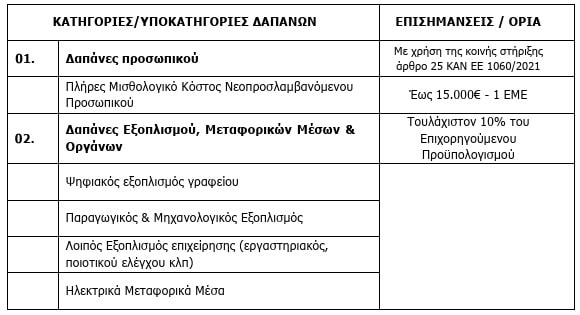
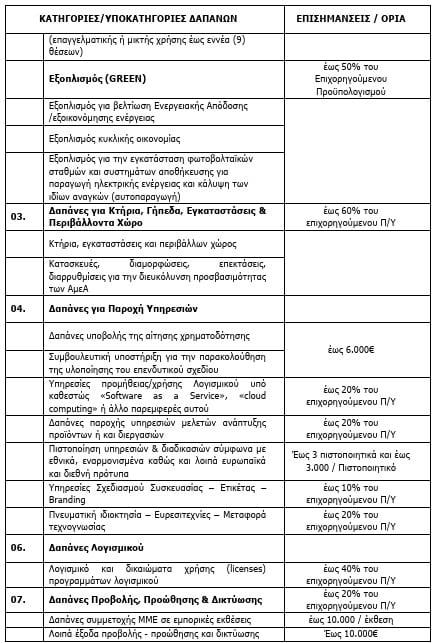
A. 10% of the Public Grant if the investment plan includes expenses of the category "Equipment (GREEN)" of the above table amounting to at least 20% of the eligible budget when the funding application is submitted. and/or
B. 5% if the investment is made in one of the following areas of Attica (Regional Unit of Islands):
- Municipality of Agistri
- Municipality of Aegina
- Municipality of Kythira
- Municipality of Poros
- Municipality of Salamina
- Municipality of Spetses
- Municipality of Troizinia-Methana
- Municipality of Hydra
Expenses subsidized
The start date for the eligibility of expenses will be the date of the call of the Action.
The eligible expenses are given in the table below:

Important dates
Submission and Evaluation of Funding Applications
The period for submitting funding applications is planned for the 2nd half of June and will be set in the Regional Governor's Decision on the Detailed Call.
The relevant funding applications will be evaluated by the direct procedure method (FiFo). Each funding application submitted will be evaluated by EFEPAE in order of priority, according to the date and time of electronic submission in OPSKE.
The call will remain open for applications until the available public expenditure and its overcommitment are exhausted, and at the latest up to six (6) months from the start date of the electronic submission of funding applications.
The start date for the eligibility of expenses is the date of the call of the Action.
The deadline for completing the funded investments may not exceed twenty-four (24) months from the date of electronic notification of the final approval of the funding application.
Supporting documents required for submission
To be announced
Book your free consultation
A 15-minute call is all it takes to find the right programs for your business.
Choose a day & time